


Sandbox In Space
4.4696.00 Reviews
App Specs
- Version
- 3.49.2
- Updated On
- License
- Free
- Downloads
- 10,000,000+
- Developer
- HOOKAH GAMES IT SERVICE L.L.C
- Categories
- Simulation
- Platform
- Android, iOS
Screenshots
 Analysis by AppCompare
I approach Sandbox In Space less as a space lesson and more as a place to experiment, make a mess, and see what happens. It is a free simulation game from HOOKAH GAMES IT SERVICE L.L.C., with a Teen age rating. The appeal is the freedom suggested by its space setting, but the experience is best judged as a playful sandbox rather than a precise scientific tool. That distinction matters: if I want a relaxed creative diversion, the loose premise is inviting; if I want structured missions or dependable astronomy lessons, I would look elsewhere.
A Cosmic Playground
Imagine having the entire universe at your fingertips. That's what Sandbox In Space offers. This app is not just about exploring the stars; it's about crafting your own little corner of the galaxy. From designing planets to orchestrating cosmic events, you can unleash your creativity in ways you might not have thought possible.
What the Space Sandbox Is—and Is Not
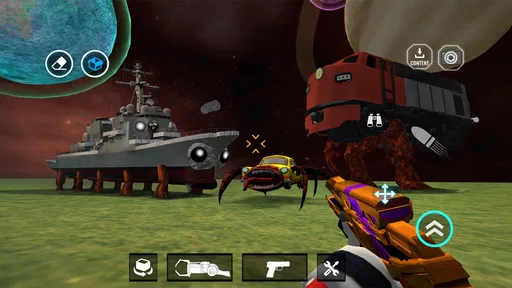
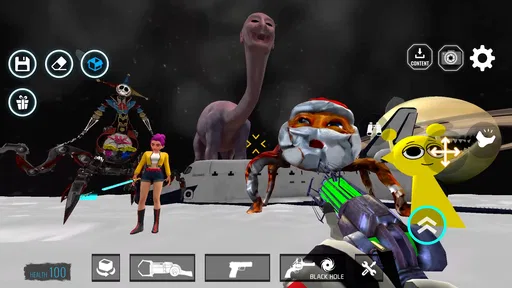
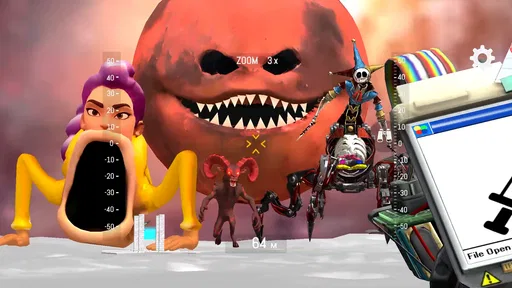
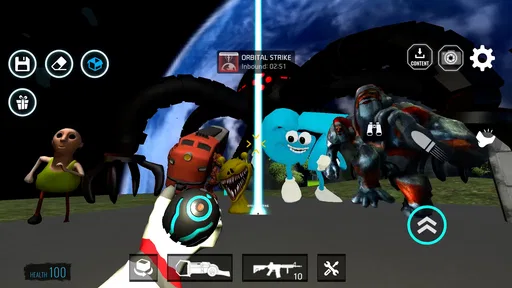
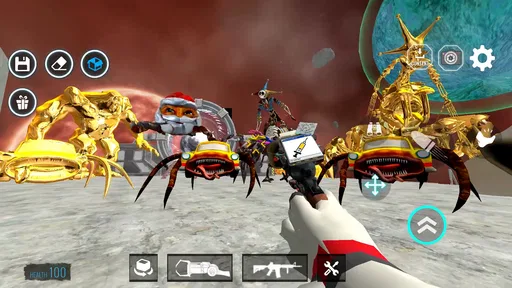
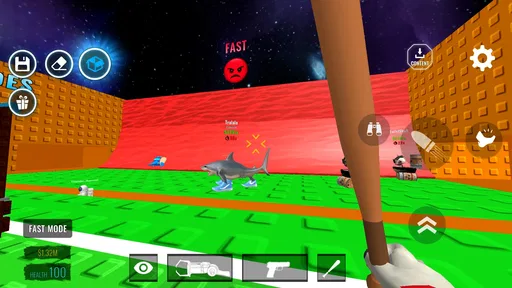
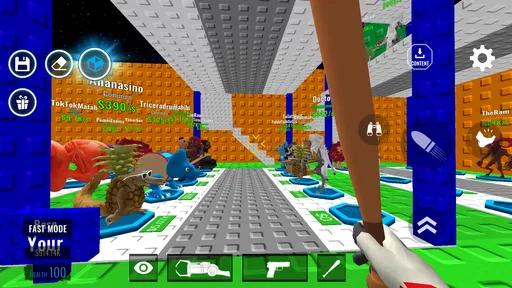
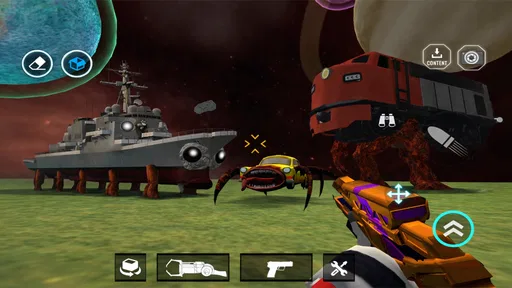
The title can set up an expectation of a calm planet-building simulator, but the game’s identity is more unruly: its store summary points to nextbots, Skibidi Toilet, and GMod-style chaos alongside the space-sandbox idea. I would go in expecting playful, unpredictable material rather than a realistic model of the universe. That contrast is a useful guide for deciding whether the game suits you: people who enjoy mixing odd characters and environments may find the premise amusing, while players seeking a serious spaceflight or astronomy simulation may find the tone too loose.
That also changes how I’d use it. Rather than treating a session as a project that needs a polished result, I’d treat it as a quick experiment: try an idea, see whether the resulting scene is entertaining, then move on or try a different arrangement. The value is in tinkering, not in following a long campaign or mastering a realistic system. The store summary is brief, so I would avoid assuming that every familiar sandbox feature is present; the safest expectation is simply an unconventional space-themed simulation with a comic edge.
Getting Started
Once you download the app, you're greeted with a sleek and intuitive interface. It doesn’t take long to get the hang of things. The tutorial is spot-on, guiding you through the basics without being overwhelming. It's like having a friendly astronaut showing you around your new space lab.
The first thing you'll likely do is create your own planet. You get to choose everything from its size to its atmosphere. Want a planet with pink skies and green oceans? Go for it! The customization options are vast, allowing for endless possibilities.
For a first session, I’d keep the goal small instead of trying to build an elaborate scene immediately. Try one clear idea, notice which controls make the result change, and then add another element only after you understand the first. That approach is especially helpful in sandbox games, where a screen full of choices can make experimentation feel less playful and more like homework. If something looks odd, I’d treat that as a prompt to test a different setup rather than a sign that the game must be played one particular way.
Worth Reading Before You Choose

EA SPORTS FC Mobile 26 Is a Bigger Football Game, but It Takes Time

Flipboard Shows What News Apps Must Do Beyond the Feed

Switching to Android Auto Means Rethinking Your Driving Routine

Google Calendar Makes a Crowded Week Easier to Manage

Ludo King Makes the Most of the Minutes Between Plans

Baby Panda World Brings Quick Play to Modern Phones, but Its Game Library Feels Busy
Play in Short Bursts, Not as a Checklist
This kind of game fits the gaps in an ordinary day better than a carefully planned evening of progression. If I had a few minutes after school or while waiting for someone, I’d open it with one simple intention—make a strange scene, try a different combination, or see what the game’s chaotic elements do together—and stop when the experiment has run its course. There is no need to turn every session into a goal-driven routine. That freedom is a strength for casual play, though it may feel aimless to someone who wants clear missions, a story, or a steady sequence of rewards.
A practical tip is to notice what you enjoyed in a session before changing everything. If a particular setup made you laugh or surprised you, use that as the starting point for the next experiment instead of rebuilding from scratch without a plan. Sandbox play can become repetitive when every attempt is random; a tiny personal challenge gives it direction without imposing a formal checklist. For example, I might try to make each new scene stranger than the last, then stop once the novelty fades. This is a way to get more out of open-ended play, not a claim that the game has a specific saved-project or challenge system.
Exploring the Depths
Beyond planet creation, the app offers a rich array of features. You can simulate astronomical phenomena, like black holes or supernovae, and watch how they interact with your creations. There's something incredibly satisfying about seeing your little universe evolve and change over time.
What’s really cool is the community aspect. You can share your creations with other users and explore what they’ve been up to as well. It’s fascinating to see the diverse cosmos others have crafted, and it often sparks new ideas for your own projects.
For me, the best comparison is with the usual alternatives in simulation games. A structured space game typically gives you explicit objectives and a clearer sense of what counts as progress; a physics-focused sandbox tends to reward careful testing and reproducible results. This game’s stated mix of space, nextbots, and internet-culture chaos points toward a more playful, less formal mood. That makes it a better pick for improvising than for learning technical rules. If I wanted a focused astronomy lesson, I’d choose an educational app; if I wanted a carefully balanced competitive match, I’d choose a game built around that. Here, the appeal is that the premise leaves room for silly experiments.
Sharing can also change the way a sandbox feels: another person’s creation may give you an idea you would not have tried alone. I’d still approach community material as inspiration rather than as a quality benchmark. The fun is not necessarily in making the most elaborate scene; a simple, surprising setup can be more enjoyable than copying a complicated one. If you prefer to keep your play private or do not care about browsing other people’s work, the core attraction should still be the act of experimenting on your own.
Stellar Graphics and Sound
The visuals in Sandbox In Space are nothing short of stunning. The developers have clearly put a lot of thought into the design, and it shows. The planets look vibrant and realistic, and the cosmic events are beautifully animated. Coupled with a soothing soundtrack, the whole experience is quite immersive.
Whether you're casually doodling with planets or diving deep into astrophysics simulations, the app consistently delivers top-notch performance. It runs smoothly with minimal hiccups, which is always a plus in my book.
I’d be cautious about reading “simulation” as a promise of scientific accuracy. The game’s chaotic framing is a better clue to its purpose: it is for amusement and creative play, not for checking facts about planetary behavior. That matters if you are choosing it for a younger player or hoping to use it as a learning aid. Its Teen rating is worth taking into account when deciding who should play, and adults should use their own judgment about whether its humor and themes fit the person using the device.
Progress, Purchases, and Fairness
The game is free to download, so trying it does not require an upfront purchase. It has optional in-app purchases priced from $0.99 to $99.99 per item. That is a wide range, and it is the main spending detail I would keep in mind before handing the device to someone else. I would not assume that paying is necessary to enjoy the basic premise, nor that a purchase guarantees a particular competitive advantage: the available purchase information does not establish what each item changes or whether the game has competitive play.
For a fair decision, I’d first play without spending and see whether the basic loop holds my interest. If a purchase prompt appears, pause and check exactly what it offers before confirming, especially if the device is shared or purchases are made by a younger player. The listed price range alone does not tell me which items are cosmetic, which affect play, or how progression works, so I would not budget around a supposed upgrade path. That uncertainty is not proof of a problem; it simply means I’d make a purchase only when its purpose is clear in the moment.
Likewise, the game’s popularity does not answer whether its play is balanced or whether paid items affect other players. It has an average rating of 4.4 from around 100,000 ratings and more than 10 million installs, but those figures tell me about reach and broad reception, not the details of fairness. I’d separate “many people have tried it” from “every system will suit me.” For someone who dislikes in-app purchase prompts, a paid game with a clearly defined one-time cost may feel more comfortable; for someone happy to test a free download and ignore optional spending, this may be an easier low-commitment experiment.
A Few Light-Years Ahead
While Sandbox In Space is mostly a joy to use, there are a few areas that could use some polish. The learning curve can be a tad steep for those new to sandbox-style apps, and it might take a bit of patience to master all the tools. However, with a little persistence, you'll find yourself zipping through the cosmos like a pro.
Another thing to note is the occasional in-app purchase prompt. While not overly intrusive, it’s something to be aware of, especially if you’re looking to unlock all the features and customization options.
That learning curve is a real reason some people may want to skip it. If I need a game that explains its goals clearly, lets me make dependable progress in every short session, or avoids purchase prompts altogether, I would choose a more structured alternative. The game is also a weaker fit if my main interest is realistic space exploration: the comic, chaotic premise points in a different direction. It should appeal most to people who enjoy experimenting without a fixed endpoint and can shrug off the occasional uncertainty of an open-ended sandbox.
Choosing It for the Right Player
I’d recommend giving it a try to someone who enjoys oddball humor, likes making their own entertainment, and does not need a conventional story to stay engaged. It could work well as a shared conversation starter too: one person can suggest a ridiculous scene, another can try to create it, and the fun comes from seeing what happens. That use case depends on the people playing together, not on a formal multiplayer feature, so I would not treat it as a promise of a particular social mode.
On the other hand, I would not pick it for someone who wants a calm, realistic space simulator, a deep campaign, or a competitive game where fairness can be judged through transparent match rules. The strongest reason to choose it is its unusual blend of sandbox freedom and deliberately chaotic subject matter. The strongest reason to pass is that open-ended play can run out of momentum if you need the game itself to supply goals and a clear sense of advancement.
Version and Practical Expectations
The game’s current version is 3.30.4, and it runs on Android 7.0 or later. It was released on October 20, 2023, and is developed by HOOKAH GAMES IT SERVICE L.L.C. Those details help me judge basic compatibility, but they do not tell me how it will perform on every device. If I were installing it on an older phone or tablet, I’d leave room for a first run to see whether the controls and presentation feel comfortable on that screen before deciding to spend time or money on it.
A common question is whether it is worth trying if I am unsure about the theme. Because the download is free, I can sample the experience without paying upfront, then decide whether its mix of space play and chaotic humor is for me. Another is whether it can replace a more serious simulator: in my view, no. I’d choose it for playful experimentation, not for accurate astronomy. And if spending is a concern, I’d keep purchases optional, review each prompt carefully, and avoid assuming that any item is required until its purpose is clear.
Trust and Final Thoughts
In conclusion, Sandbox In Space is a stellar app for anyone with a sense of wonder and a love for space. It provides a creative outlet for your wildest cosmic ideas while also offering an engaging and educational experience. Whether you're a seasoned space enthusiast or just looking for something new to explore, this app is worth a download. So, why not give it a go and see where your imagination takes you?
My recommendation comes with one important qualification: I’d describe it as a casual, unusual sandbox rather than a dependable educational simulator. The free entry point makes it easy to test, while the Teen rating and optional purchases are worth considering before installing it for someone else. Its audience figures—more than 660 written reviews alongside its broad install count—suggest a well-tried game, but they cannot settle personal questions such as whether its humor, controls, or open-ended style will click for you. I would start with a no-spend session, try a small creative idea, and decide from that experience. If the combination feels amusing, it has a clear niche; if you want structured goals, scientific realism, or fully transparent purchase value, a different kind of simulation will be a better fit.
Pros
- Immersive space exploration experience.
- Wide variety of missions and challenges.
- Customizable spacecraft options.
- Engaging graphics and sound design.
- Regular updates with new content.
Cons
- Occasional in-game performance glitches.
- Some missions can be repetitive.
- Requires a stable internet connection.
- In-app purchases can be pricey.
- Limited offline gameplay options.
FAQs for Sandbox In Space
What is Sandbox In Space?
Sandbox In Space is an innovative game that lets players explore and create within an expansive outer space environment. It offers a unique blend of creativity and adventure, allowing users to build structures, experiment with physics, and interact with various cosmic elements. Perfect for both casual players and those seeking deeper gameplay.
Is Sandbox In Space free to play?
Yes, Sandbox In Space is free to download and play. However, it includes optional in-app purchases that can enhance the gaming experience. These purchases might include special items, expanded building tools, or aesthetic upgrades. Players can enjoy the core features without spending money, but additional content may require purchase.
What are the system requirements for Sandbox In Space?
To run Sandbox In Space smoothly, Android devices should have at least version 8.0, while iOS devices need iOS 12.0 or later. The game is optimized for modern smartphones and tablets, but older devices may experience performance issues. Ensure you have enough storage space, as the game requires approximately 500 MB.
Does Sandbox In Space require an internet connection?
Sandbox In Space does not require a constant internet connection for basic gameplay, making it ideal for offline play. However, certain features, like online multiplayer modes or updates, will need internet access. Players can enjoy creating and exploring without connectivity, but some functionalities are enhanced online.
Can I play Sandbox In Space with friends?
Yes, Sandbox In Space offers multiplayer modes allowing you to collaborate or compete with friends. You can join or create private servers to explore and build together, or participate in challenges. Multiplayer mode enhances the experience by fostering creativity and teamwork, but it requires an internet connection.


